
Instead of presenting Local SEO as a list of universal tricks, Let's Buzz Media documents what happens when the methods are applied to a real local business over time. The purpose is not to create a polished "success story" after the event.
It is to show the starting position, real constraints, changes, measurements, uncertainty and decisions that follow.
Why we are running a live case study
Local SEO advice often mixes several different things:
- rules or features that Google explicitly documents;
- industry testing and practitioner experience;
- opinion based on what seems to work;
- anecdotes from one business;
- genuine first-hand measurement.
Those can all be useful, but they should not be presented as the same kind of evidence. A live project lets readers see the implementation context that is usually missing from a simple list of recommendations.
It shows what a business was trying to achieve, what resources it had, what changed at the same time, what data was available and whether the business outcome matched the search visibility. It also makes failure harder to hide.
If an idea is tested and nothing useful happens, that still teaches us something. If the data is too weak to support a conclusion, that belongs in the record too.
One case study can inform a decision. It cannot prove a universal Local SEO rule.
The Methodology explains how Let's Buzz Media handles that limitation.
Current project: McKnight's Flat Pack Assembly
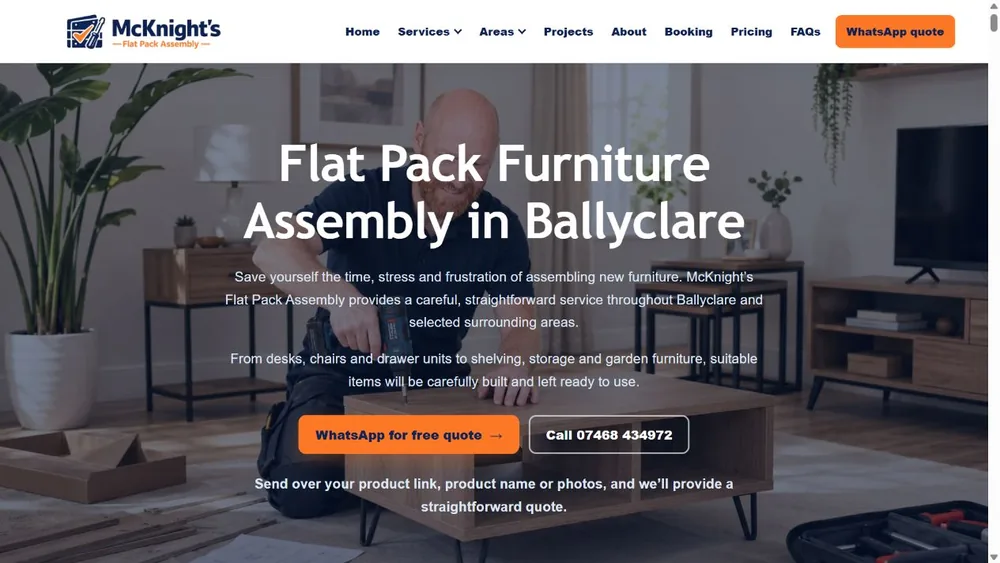
The principal live project at launch is McKnight's Flat Pack Assembly. It is a genuine service-area business based in Ballyclare, Northern Ireland.
The business assembles flatpack furniture at customers' locations rather than operating as a customer-facing shopfront. That operating model makes it useful for studying several practical Local SEO questions:
- how a new service-area business should structure its website;
- how Google Business Profile should reflect a business that travels to customers;
- how service and geographic intent should be mapped to pages;
- when a town or service-area page is justified;
- how real jobs, photographs and reviews can become first-hand business evidence;
- how visibility and enquiries change as the business develops geographically.
The project is ongoing. Some website and profile work was already in place before the formal Let's Buzz Media case-study record was established, so the record separates earlier implementation from measurements collected from a defined baseline onwards.
Follow the full McKnight's Flat Pack Assembly project record.
How the case study is documented
The project record is built around a consistent set of questions.
Starting point
What already existed when the formal record began? Which parts were implemented before reliable measurement was available?
What can be reconstructed and what cannot?
Goals and constraints
What is the business trying to achieve, and what limits the strategy? A one-person assembly business, for example, has capacity and service constraints that should affect targeting.
More visibility is not automatically useful if it produces enquiries for work the business cannot take.
Changes made
Material website, profile, content, review, authority and measurement changes are recorded by date or stage where possible.
Measurements
The project uses the data that can answer the question reliably rather than reporting every available metric.
Results and observations
What happened after the change? Was the movement large enough to matter?
Was it visible in more than one data source?
Limitations and confounding factors
What else changed at the same time? Could seasonality, competitors, platform changes or a small sample affect the interpretation?
What did not work
Neutral and negative findings remain part of the record. The purpose is learning, not protecting a predetermined narrative.
How the case study connects to the guides
Let's Buzz Media separates education from project evidence so one page does not have to do both jobs badly. An educational guide explains the principle and the wider evidence.
A Real Project module shows how that principle was applied in McKnight's Flat Pack Assembly. A case-study chapter is created only when there is enough genuine material to justify a separate page with its own question, dates, measurements and conclusions.
This means the case study can reference the Service-Area Business SEO guide for the underlying business-model theory rather than rewriting it. The project page then focuses on what was actually implemented.
What we measure
The measurement framework follows the same hierarchy used across the site.
Search visibility
This can include Search Console impressions and queries, indexed pages and repeatable ranking observations where useful.
Maps and geographic visibility
Where comparable scans are available, geo-grid tracking can show how Maps visibility changes across an area rather than relying on one search from one location.
Google Business Profile interactions
Profile performance data may be used where the date range and metric are reliable and comparable.
Website engagement
Clicks, landing-page activity and other website behaviour can help explain whether search visibility is reaching relevant users.
Enquiries, quotes and jobs
Where they can be logged reliably, these are more important business outcomes than ranking screenshots. Geographic origin can also help judge whether expansion into another area is commercially useful.
Reviews and first-hand business evidence
The project records legitimate review activity and the real jobs, photographs and customer questions that can support useful content. Use the Local SEO Measurement guide for the full framework.
What we will not do
The case study will not be made more dramatic by manufacturing problems or results. We will not:
- create fake reviews or links;
- use fake business locations;
- invent ranking drops or recovery stories;
- publish fabricated before-and-after photography;
- claim that a coincident change proves causation;
- force every Local SEO topic to appear in the project;
- publish an empty case-study chapter simply because it exists in the long-term architecture.
These standards are also covered in the Editorial Policy.
Case-study timeline
August 2026 - Initial business and website development Core service, manufacturer and service-area content was developed, alongside Google Business Profile work and the first documented customer-project content. 1 September 2026 - Formal Let's Buzz Media case-study record established The project is being documented as a longitudinal Local SEO case study.
Earlier implementation is preserved as prior work rather than treated as a clean experimental baseline. Current phase - Baseline and measurement The priority is to record reliable starting data, continue logging material changes and measure visibility, engagement and business outcomes before drawing strong conclusions.
Future updates Separate chapters will be published only when a topic has enough genuine evidence and distinct value. Planned subjects may include starting position, keyword research, website architecture, Google Business Profile, location pages, reviews, geographic expansion, results and change history.
These should remain plain text until the relevant page is actually published.
Follow the project
The main living record is the McKnight's Flat Pack Assembly Local SEO case study. For how observations are judged, read the Methodology.
Updates should be dated so readers can distinguish the current state from the project's history.