
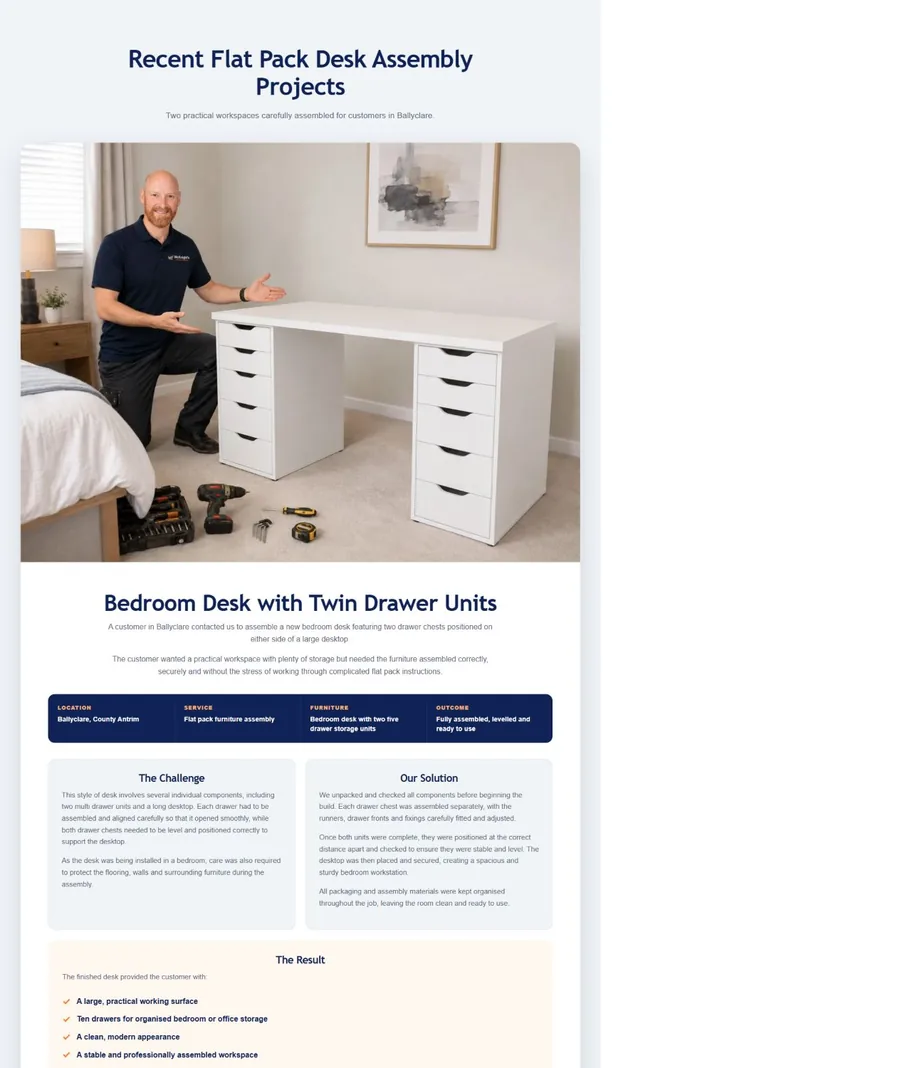
Public project evidence
These public views provide context for the project. They are dated snapshots, not permanent claims about ratings, follower counts or visibility.
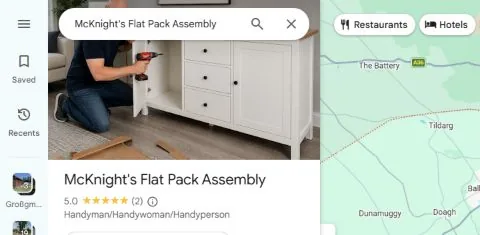
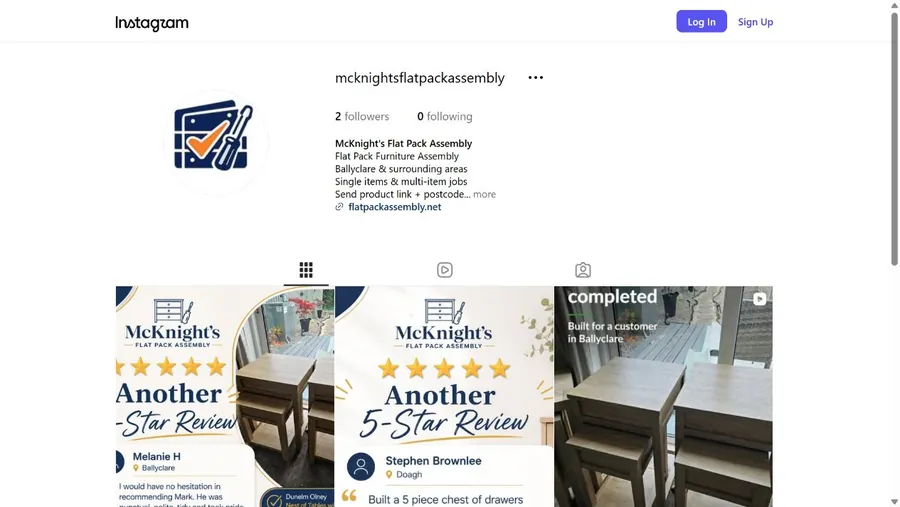
This page records the Local SEO work carried out on a real service-area business, what changed, what is being measured and what we can - and cannot - conclude from the results. The project is live.
It should be read as a field record rather than a finished success story.
Project snapshot
- Status
- Live and ongoing
- Business
- McKnight's Flat Pack Assembly
- Business model
- Service-area business working at customers' locations
- Geographic base
- Ballyclare, Northern Ireland
- Website
- flatpackassembly.net
- Formal record began
- 1 September 2026
- Primary goal
- Relevant local enquiries and booked assembly work
- Current phase
- Baseline, measurement and controlled geographic development
The business and its real-world constraints
McKnight's Flat Pack Assembly is a one-person flat-pack furniture assembly service based in Ballyclare. The business travels to customers rather than operating from a customer-facing shop or showroom.
That operating model creates useful Local SEO constraints because the search strategy has to reflect what the business can genuinely deliver. The service is carried out at the customer's location The customer journey normally begins with a person looking for help assembling furniture.
Before a booking is accepted, the business needs enough information to understand the product, quantity, location and likely workload. At a high level, the enquiry process is:
- the customer provides a product link or enough information to identify the furniture;
- the quantity and postcode are checked;
- the work is reviewed for suitability, including whether it can reasonably be completed by one person;
- a fixed quote is provided before booking;
- the assembly is completed at the customer's location.
This matters for SEO because an enquiry is only useful if the business can actually serve the area and complete the item safely and practically. One-person assembly limits the service range The business is deliberately positioned around furniture that can be assembled by one person.
Items that require two people or fall outside the practical service model are not a good target simply because they have search demand. That constraint should influence service-page decisions, manufacturer content, location targeting and the way success is measured.
More traffic is not automatically better if it creates unsuitable enquiries. The business is a service-area business, not a walk-in shopfront Customers are served at their own locations.
The case study therefore follows the principles covered in the Service-Area Business SEO guide and the specialist Google Business Profile for service-area businesses guidance. The project record should never expose a private residential or operational address simply to make the case study look more complete.
Starting position
The starting position for this case study needs to be divided into two parts: the business development work already completed during August 2026 and the formal measurement record beginning on 1 September 2026. Website and domain The business website is flatpackassembly.net.
By the time the formal case-study record was established, the site had moved beyond a single homepage and already contained a structured set of service, manufacturer and service-area pages. The core architecture included:
- a Ballyclare-focused homepage;
- Bedroom Furniture Assembly;
- Office Furniture Assembly;
- Living Room Furniture Assembly;
- Dining Furniture Assembly;
- Children's Furniture & Toy Storage Assembly;
- Hallway & Utility Furniture Assembly;
- Bathroom Furniture Assembly;
- Garden Furniture Assembly;
- an IKEA Furniture Assembly Ballyclare page;
- a Dunelm Furniture Assembly Ballyclare page;
- an Antrim service-area page;
- a Newtownabbey service-area page.
This gives the project a real architecture to evaluate: service intent, manufacturer intent and geographic intent are handled by different pages rather than being collapsed into one generic page. Google Business Profile A Google Business Profile had been created and was being developed for the business before the formal case-study baseline.
The profile is part of the ongoing measurement plan, but this page does not claim a specific ranking, interaction count or improvement because no verified baseline dataset has been supplied for publication here. Where later updates discuss profile visibility or interactions, they should use a clear date range and the source data available at that time.
Reviews and first-hand project evidence
By August 2026, the business had begun collecting genuine first-hand evidence from completed work. A documented Ballyclare job involved assembling two Dunelm Olney nest-of-tables sets.
The project was photographed and a genuine customer review was received afterwards. This material is useful because it can support project content and demonstrate real work without manufacturing experience for SEO purposes.
This page deliberately avoids publishing the customer's name or private information. Search and Maps visibility baseline A clean historical ranking baseline has not been supplied for the period before the website and profile work began.
That means this case study should not publish a fictional "before Local SEO" ranking or traffic chart. Where Search Console, Business Profile performance or geo-grid records are available from a defined date onwards, those can form the reliable baseline for future comparisons.
Current status: baseline measurement is being established and historical implementation is being documented separately from later measured changes.
Project goals
The project has several goals, and they should not be reduced to "rank number one". Generate relevant local enquiries and booked jobs The strongest business outcome is suitable work from customers the business can genuinely serve.
Visibility is useful only when it contributes to that outcome. Establish sustainable visibility in the core area Ballyclare is the core geographic base.
The project aims to build a strong, accurate local presence there before judging wider geographic expansion only by page count or map coverage. Test geographic expansion carefully Antrim and Newtownabbey already have dedicated service-area pages.
The next question is not simply whether more towns can be added, but whether the existing pages generate useful visibility and enquiries and whether further areas have enough distinct commercial value to justify their own content. Build a real evidence base for Let's Buzz Media The project is also the principal live case study for Let's Buzz Media.
It should produce a record of implementation decisions, measurements, neutral results and limitations that can be referenced from educational guides. Avoid shortcuts that weaken the evidence The project will not rely on fake locations, review manipulation, mass-produced town pages or fabricated case-study outcomes.
Strategy
The detailed theory belongs in the educational guides. The project strategy is summarised here so readers can understand the implementation without turning this page into another complete Local SEO guide.
Keyword and intent mapping Search demand is mapped to the page that best owns the intent rather than creating one URL for every keyword variation. Service categories, manufacturer searches and geographic searches are treated as different forms of intent.
The Keyword Mapping guide owns the wider methodology. Website architecture The site uses a clear homepage, distinct service pages, selected manufacturer pages and a limited number of geographic pages.
The architecture is intended to make each page useful for a real customer question. It is not designed around producing as many indexable town-and-service combinations as possible.
Google Business Profile The profile is being developed to match the real service-area business. The detailed implementation belongs in Google Business Profile for service-area businesses.
Service-area and location content Geographic pages are treated as a qualification decision. Antrim and Newtownabbey were selected as genuine service areas rather than the start of an unrestricted town-page network.
The educational framework is covered in Service-Area Location Pages.
Reviews and proof
The project uses genuine completed work, photographs and legitimate customer reviews as business evidence. Review acquisition should remain neutral and policy-compliant rather than being manipulated for keywords or rating outcomes.
See How to Get Google Reviews for the wider process. Citations and links Business listings and links are treated as accuracy and authority questions rather than quota targets.
Any future case-study claim in this area should record the source, date and reason the listing or link was pursued. Measurement Measurement should move from search visibility to engagement, leads and real jobs where the data can be recorded reliably.
The full framework is in Local SEO Measurement.
What has been implemented so far
The table below records implementation that is supported by the current project information. It is deliberately descriptive rather than claiming that each item produced a ranking improvement.
Stage Implementation What we know at 1 September 2026 August 2026 Core homepage and Live website architecture built around Ballyclare plus distinct furniture service-page structure categories. August 2026 Manufacturer pages Dedicated IKEA and Dunelm furniture assembly pages created for Ballyclare intent.
August 2026 Service-area pages Dedicated Antrim and Newtownabbey pages created. August 2026 Google Business Profile Profile created and developed for the service-area business.
No verified ranking/interaction baseline is claimed here. August 2026 Real project content A genuine Dunelm Olney furniture assembly job in Ballyclare was photographed and documented.
August 2026 Customer review evidence A genuine customer review was received after completed work. The case study does not publish private customer details.
1 September Formal Let's Buzz Media The project is converted into an explicit longitudinal case study with 2026 record evidence labels, change logging and measurement requirements. Homepage and service pages The homepage is designed to own the broad Ballyclare furniture-building service intent, while individual service pages handle meaningful categories such as bedroom, office, living room and dining furniture.
This avoids forcing every service into the homepage and gives the case study a useful test of whether page architecture can match distinct customer intent. IKEA and Dunelm manufacturer pages The site includes dedicated manufacturer pages for IKEA and Dunelm furniture assembly in Ballyclare.
These pages are useful case-study material because they test manufacturer-led demand without turning the whole site into one page per product model. The long-term question is whether this intent attracts relevant impressions, clicks and enquiries and whether additional manufacturer pages would be justified by real demand.
Antrim and Newtownabbey service-area pages These pages extend the website beyond the Ballyclare core while remaining within genuine service coverage. They are important to the geographic-expansion part of the case study.
The next decision should be evidence-led: measure visibility and enquiries, assess content usefulness, then decide whether another area deserves a separate page. Google Business Profile setup and development The profile is part of the business's local-search presence and should be assessed alongside the website rather than as a separate marketing project.
At this stage, the case study records that GBP work has been implemented. It does not publish an invented baseline or attribute any result to a profile field without supporting data.
Reviews and project content
The first documented job content gives the site real photographic and customer evidence that can be used in a way generic SEO copy cannot replicate. The purpose is not to produce a thin page for every job.
Project content should be published when it adds meaningful proof, useful detail or a customer-focused lesson.
What we are measuring
The project will report only measurements that can be traced to a source and date range. Search Console Relevant measures include:
- impressions by page and query;
- clicks;
- query groups associated with service, manufacturer and geographic intent;
- whether new pages begin to appear for the searches they were designed to satisfy.
- Which pages or areas produce suitable enquiries?
- Are wider-area enquiries commercially worthwhile after travel?
- Do manufacturer pages attract the kind of work the business can accept?
Private customer details should not be published.
Reviews
Reviews can be recorded by date and linked to the operational review-request process. The case study should not ask customers to include target keywords or create an artificial review pattern.
Current observations
What has not worked or remains uncertain
At launch, there is not enough verified evidence to publish a list of failed SEO experiments. That is preferable to inventing one.
The main uncertainties are:
- the absence of a clean pre-implementation ranking and traffic baseline;
- the amount of Search Console data available for each newer page;
- how much visibility the Antrim and Newtownabbey pages will gain over a longer period;
- whether manufacturer-specific pages will produce commercially useful enquiries;
- how Maps visibility changes across the wider service area once comparable geo-grid scans are recorded;
- how much each individual change contributes when website, GBP, reviews and content are developing together.
These should be converted into dated findings only when the evidence supports them.
Current experiments and next actions
The next phase is measurement-led rather than page-count-led. Establish a reliable measurement baseline Record Search Console, relevant GBP performance data, repeatable local visibility measurements and enquiry/job information from a clear start date.
Evaluate existing geographic pages before multiplying them Measure Antrim and Newtownabbey rather than assuming more town pages are automatically the next step. The decision to create another geographic page should consider genuine service coverage, commercial value, local search intent, available proof and the ability to add distinct useful content.
Track manufacturer intent Monitor whether the IKEA and Dunelm pages attract relevant queries and suitable enquiries. Additional manufacturer pages should be based on demand and usefulness rather than a desire to create more URLs.
Develop the review and project-evidence process Continue to collect genuine reviews and real project material without turning every job into a templated SEO page. Preserve the change log Material changes should be dated from this point onwards so later observations can be interpreted against a clearer history.
Change log
August 2026 Core Ballyclare-focused site, furniture-category service pages and initial Local SEO structure developed. August 2026 IKEA and Dunelm manufacturer pages created.
August 2026 Antrim and Newtownabbey service-area pages created. August 2026 Google Business Profile setup/development carried out.
August 2026 First documented real-job content and customer review evidence recorded. 1 September Let's Buzz Media formalises McKnight's Flat Pack Assembly as the principal live Local SEO case 2026 study and begins a more explicit longitudinal measurement record.
Future entries should record material changes only. Dedicated case-study chapters should be linked here only once they contain enough genuine evidence to publish.
What this case study can and cannot prove
This project can show:
- how a real service-area business makes Local SEO decisions;
- how website, GBP, reviews, content and measurement are implemented together;
- what happened to specific pages or metrics over defined periods once reliable data exists;
- which ideas produced useful commercial outcomes for this business;
- which ideas produced no clear result or remained inconclusive.
It cannot prove:
- that the same result will occur in every industry or town;
- that one observed ranking movement was caused by one change when other variables moved too;
- that Ballyclare and the surrounding Northern Ireland market behave like every UK market;
- that a short measurement window captures seasonality or long-term platform effects;
- that one review, page, link, schema change or profile edit is a universal ranking lever.
The case study should therefore be used alongside the broader evidence framework in the Methodology, not as a replacement for it. For the system behind this project, return to the Case Study hub.
Related educational guides
- Service-Area Business SEO
- Google Business Profile for Service-Area Businesses
- Local Keyword Mapping
- Service-Area Location Pages
- How to Get Google Reviews
- Local SEO Measurement
- Let's Buzz Media Methodology